Monday, May 30, 2011

Gulliver's Travels

Gulliver's Travels
Release Date: 12/22/1939
Distributed by: Paramount Pictures
Studio: Fleischer Studios
Running Time: 75 Minutes
Director: Dave Fleischer
Producer: Max Fleischer

Historical Significance:
- second cel-animated feature film ever released
- first produced by an American studio other than Walt Disney Productions
- first animated movie to feature rotoscoping

Background:
Max and Dave Fleischer had wanted to produce a feature as early as 1934, but Paramount, who distributed Fleischer's Popeye, Betty Boop, and Screen Songs cartoon shorts, vetoed the idea. However, after the success of Snow White and the Seven Dwarfs, Paramount agreed to allow the Fleischers to make a feature. Paramount offered to build the New York City-based Fleischers a new state-of-the-art animation studio in Miami Beach, Florida, away from the union influence which had polarized the Fleischer Studio after a bitter 1937 labor strike. The Fleischers agreed, and began development on Gulliver's Travels in spring 1938 as construction began on the Miami studio. The Miami Fleischer Studio opened in fall 1938, and the Fleischer staff moved their production headquarters there. 
Plot Summary:
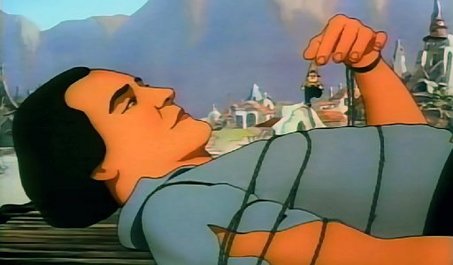
     Gulliver washes ashore on Lilliput and attempts to prevent war between that tiny kingdom and its equally-miniscule rival, Blefiscu, as well as smooth the way for the romance between the Princess and Prince of the opposing lands. In this he is alternately aided and hampered by the Lilliputian town crier and general fussbudget, Gabby. A life-threatening situation develops when the bumbling trio of Blefiscu spies, Sneak, Snoop, and Snitch, manage to steal Gulliver's pistol.
     
Voice Cast:
Gulliver: Sam Parker
Gabby: Pinto Colvig
King Little, Sneak, Snoop, and Snitch: Jack Mercer
King Bombo: Tedd Pierce
Princess Glory: Jessica Dragonette
Prince David: Lanny Ross
Animation Style and Production:
     Paramount wanted Gulliver ready for a Christmas 1939 release, meaning that the film would have to be produced on a timetable that was one-third of that for the production of Disney's Snow White. To meet this deadline, the Fleischer staff was greatly expanded, to the point that the once-spacious new building was overcrowded with employees. Local Miami art schools provided graduates to be trained as ink-and-paint artists and in-betweeners. Animators were lured from the Hollywood animation studios, including Cal Howard, Virgil Ross and Tedd Pierce from Leon Schlesinger Productions, and former Fleischer employees Grim Natwick, Al Eugster, Frank Smith and James Culhane, who had all migrated over to the Disney studio. Factions developed between the East and West Coast animators, who were unaccustomed to each others' habits. The two sides grew further apart after Howard, Pierce, and the other Hollywood storymen decided to discard the New York regime's storyboards, crafting the film's plot over again from scratch.
     Rotoscoping, an animation technique originally developed by the Fleischer Studios, was used throughout Gulliver's Travels to animate Gulliver. The process involves tracing live-action footage frame-by-frame; Sam Parker, the actor who performed the voice of Gulliver, also modeled as the character's live-action reference. Popeye the Sailor had originally been planned to "portray" Gulliver, but these plans were scrapped during pre-production.
Differences from Book:
    The story is based upon the Lilliputian adventures of Gulliver depicted in Jonathan Swift's 18th century novel Gulliver's Travels.

Music:
     Songs in the film include "All's Well", "It's a Hap-Hap-Happy Day", and "Faithful Forever", all of which later became standards of Fleischer cartoon scores.

Funny Tidbits You Didn't Know: 
- The film was spun off into two short-lived Fleischer cartoon short series: the Gabby cartoons starring the Pinto Colvig-voiced Lilliputian sidekick of the film, and the Sneak, Snoop and Snitch (Animated Antics) cartoons starring the three villains from the film. 
- Like Snow White before it, Gulliver was a box-office success, and led to the production of another Fleischer/Paramount feature, Mister Bug Goes to Town. However, business-related problems which arose during the production of Mister Bug would result in Paramount's absorption of the Fleischer Studio in 1941, as the studio was in debt from unsuccessful cartoons and the simmering feud between Max and Dave reached new heights, as Dave had wanted to write the score for the film. Gulliver's Travels is now in the public domain, because its copyright was not renewed, and is widely available on home video and DVD.

Snow White and the Seven Dwarfs

Snow White and the Seven Dwarfs
Release Date: 12/21/1937
Distributed by: RKO Radio Productions
Studio: Walt Disney Productions
Running Time: 83 minutes
Supervising Director: David Hand
Producer: Walt Disney

Historical Significance: 
-first full-length cel-animated feature in motion picture history
-first animated feature film produced in America
-first produced in full color
-first to be produced by Walt Disney
-first in the Walt Disney Animated Classics canon

Background:

     Snow White and the Seven Dwarfs is the first full-length animated feature in color and with sound, one of Disney's greatest films, and a pioneering classic tale in film history. It was financed due in part to the success of Disney's earlier animated short, The Three Little Pigs (1933). Although dubbed "Disney's Folly" during the three-four year production of the musical animation, Disney realized that he had to expand and alter the format of cartoons.
     It was the first commercially successful film of its kind and a technically brilliant, innovative example of Disney animation. It was the first film with an official soundtrack and the first film to release a motion picture soundtrack album. The story was adapted from the original Brothers Grimms' Fairy Tales, but in a bowdlerized or sanitized version, without overt sexual references or violent content.

Plot Summary:
     The story is a familiar one: raised by a wicked and vain Queen, beautiful Snow White is taken into the forest to be murdered. However, the Huntsman cannot commit the horrible deed, so she flees and finds refuge in the home of seven diamond-mining dwarfs, each with a unique characteristic. When the Queen discovers that Snow White is still alive, she transforms herself into an old hag and brings a poisonous apple to the young girl. A kiss from Prince Charming rouses Snow White from her deep slumber.

Voice Cast:
Snow White: Adriana Caselotti
Queen: Lucille La Verne
Magic Mirror: Moroni Olsen
Doc: Roy Atwell
Happy: Otis Harlan
Bashful: Scotty Mattraw
Sneezy: Billy Gilbert
Sleepy: Pinto Colvig
Grumpy: Pinto Colvig
Dopey (mute)
Prince Charming: Harry Stockwell
Huntsman: Stuart Buchanan

Animation Style and Production:
The risk-taking film made use of the multi-plane camera, the first used in Disney's own animated, Oscar-winning Silly Symphonies short, The Old Mill (1937), to create an illusion of depth. It introduced human characters (the jealous Queen, the Huntsman, the Prince, and Snow White herself) modeled on live actors, and used larger painted cels and drawing boards. It took almost four years and an astronomical (at the time) $1.7 million to create, and was released for its premiere during the Christmas season of 1937.

Awards and Nominations:
Its single nomination was for Best Score. For the film's remarkable achievement, Walt Disney was awarded with an Honorary Oscar - the film was "recognized as a significant screen innovation which has charmed millions and pioneered a great new entertainment field for the motion picture cartoon."


Differences from Fairy Tale:
                  Though Disney's Snow White and the Seven Dwarfs is similar to the fairy tale version, there are several differences. In the fairy tale, Snow White's mother wishes for a child with "lips as red as blood, hair as dark as the window frame, and skin as white as snow." This does not occur in the film, as Disney's Snow White is shown with only her stepmother, the Queen, and there is no scene of her biological mother.
                  In the fairy tale, Snow White accepts three gifts from the witch (a girdle, a poisoned comb, and the apple), but is rescued from the first two gifts by the dwarfs. When she is offered the apple, she is unwilling to eat it and only accepts after the witch takes a bite of the apple that is not poisoned. However, in the film, Snow White only accepts one gift (the apple) from the witch after she helps the witch inside the dwarfs' house (some of the woodland birds attacked the witch as a warning, which was misinterpreted by Snow White). She bites the apple after being told that the apple is magical and that one bite will make all of her dreams come true (namely marrying the Prince).
                  In the fairy tale, Snow White is not awakened by the prince's kiss. Instead, the prince buys the coffin and Snow White's body from the dwarfs and has it carried with him towards his castle. During the journey, a piece of apple in Snow White's throat becomes dislodged and she awakens.
                  Lastly, in the fairy tale, Snow White faces her stepmother one final time after eating the poisoned apple. The stepmother attends the wedding of Snow White and the prince, but she is stopped from causing further harm by being forced to wear hot iron shoes to her death. In the film, the stepmother (as the witch) is chased up to the top of a mountain by the dwarfs after giving Snow White the poisoned apple: when she tries to dislodge a boulder onto the dwarfs to kill them, lightning strikes the edge she is standing on and she falls to her death, along with the boulder falling and presumably crushing her.

Music:
     The songs in Snow White and the Seven Dwarfs were composed by Frank Churchill and Larry Morey. Paul J. Smith and Leigh Harline composed the incidental music score. Well-known songs from Snow White and the Seven Dwarfs include "Heigh-Ho," "Some Day My Prince Will Come," and "Whistle While You Work." Because Disney did not have its own music publishing company at this time, the publishing rights for the music and songs were administered through the Bourne Co., which continues to hold these rights. In later years, the studio was able to acquire back the rights to the music from many of the other films, but not Snow White. Snow White and the Seven Dwarfs became the first American film to have a soundtrack album released in conjunction with the feature film. Prior to Snow White and the Seven Dwarfs, a movie soundtrack recording was unheard of and of little value to a movie studio.


Funny Tidbits You Didn't Know:
-The dwarfs names were chosen from a pool of about fifty potentials, some of which included Jumpy, Deafy, Dizzey, Hickey, Wheezy, Baldy, Gabby, Nifty, Sniffy, Swift, Lazy, Puffy, Stuffy, Tubby, Shorty and Burpy.

-The famous forest scene was one of the scariest scenes ever created by Disney. When the movie was released back in 1937, children were afraid to watch this scene because of the scary eyes that appear towards the end, and because it all seems real. That's why in England, the film got a G-Rating, but it said that younger children should be accompanied by an adult due to some intense and scary scenes.

Movie Links:
http://www.putlocker.com/file/2E5042D1304D7198
http://www.sockshare.com/file/FCF3ECD211079FF0

AniNation begins!

Since summer looks like its going to be boring, I decided to create a blog on animation I guess. Tell me what you think and how I can improve it! Thanks!